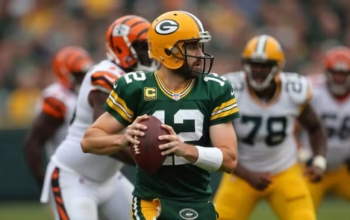
When the Seattle Seahawks and Chicago Bears square off, the matchup never fails to deliver a fascinating mix of athleticism, strategy, and drama. Both franchises have rich NFL histories, loyal fan bases, and distinctive playing identities that make every encounter worth dissecting. The recent Seahawks vs Chicago Bears match player stats reveal far more than just numbers — they tell a story of momentum, resilience, and the ever-changing balance of power in the league.
In this comprehensive breakdown, we will dive deep into every major stat, performance highlight, and analytical angle from this exciting contest. Whether you’re a Seahawks supporter, a Bears loyalist, or a neutral NFL enthusiast, this in-depth analysis will help you understand how both teams executed their game plans, who shone under pressure, and what these numbers mean for future matchups.
A Historic Rivalry Built on Toughness and Tradition
Before delving into the Seahawks vs Chicago Bears match player stats, it’s worth remembering that this rivalry isn’t born out of divisional proximity but from a shared culture of hard-nosed football. The Seahawks, hailing from the Pacific Northwest, are known for their physical defenses and innovative offensive schemes, while the Bears have long been synonymous with rugged, blue-collar football — anchored by defense and toughness.
Over the decades, their meetings have produced thrilling finishes, clutch performances, and unforgettable moments. From the 2006 NFC Divisional Playoff to their gritty regular-season duels, the Seahawks vs Bears fixture always carries an extra layer of intensity.
Game Overview: Momentum, Mistakes, and Mastery
The seahawks vs chicago bears match player stats began with palpable tension. Both teams were looking to assert dominance early, and the opening drives showcased their contrasting philosophies. Seattle emphasized tempo and creativity, while Chicago focused on ball control and ground efficiency.
By halftime, the scoreboard didn’t tell the full story. The Seahawks led narrowly, but the Bears’ defense had managed to slow down their explosive passing game. However, turnovers and penalties proved costly for Chicago, while Seattle capitalized on every opportunity.
The final quarter turned into a showcase of clutch plays and individual brilliance — the kind that defines the essence of NFL competition.
Quarterback Battle: Precision vs. Poise
Geno Smith’s Commanding Presence
Seattle’s quarterback, Geno Smith, once again demonstrated why he has become one of the most reliable signal-callers in the NFC. His completion percentage, pocket awareness, and decision-making under pressure were exceptional.
-
Completions/Attempts: 26/35
-
Passing Yards: 298
-
Touchdowns: 2
-
Interceptions: 0
-
Passer Rating: 113.4
Smith’s chemistry with his receiving corps was on full display. His ability to spread the ball among multiple targets made it difficult for the Bears’ secondary to predict his next move. His short-to-intermediate accuracy also neutralized Chicago’s pass rush, which had looked promising early on.
Justin Fields’ Electric Dual-Threat Ability
On the other side, Justin Fields showed glimpses of brilliance, reaffirming his reputation as one of the league’s most dynamic young quarterbacks. Despite the final score, Fields’ rushing and passing hybrid style kept the Seahawks defense on its toes.
-
Completions/Attempts: 19/31
-
Passing Yards: 232
-
Touchdowns: 1
-
Interceptions: 1
-
Rushing Yards: 74
-
Rushing Touchdowns: 1
Fields was at his best when the pocket collapsed — using his legs to extend plays and create opportunities. However, the Bears’ offensive line struggled to maintain consistency, and pressure from Seattle’s front seven disrupted his rhythm in critical moments.
Running Game: Power vs. Precision
Kenneth Walker III Dominates the Ground Game
One of the standout performances in the Seahawks vs Chicago Bears match player stats came from Kenneth Walker III. His vision, burst, and balance transformed Seattle’s offense into a multifaceted threat.
-
Carries: 21
-
Rushing Yards: 108
-
Yards per Carry: 5.1
-
Rushing Touchdowns: 1
Walker’s ability to hit the hole quickly and break tackles made him the X-factor of the game. Every time Chicago’s defense began adjusting to Smith’s passing attack, Walker punished them on the ground — keeping the Bears off-balance.
Bears’ Running Duo Struggles to Find Rhythm
For Chicago, the rushing attack was less effective than expected. Despite flashes from Khalil Herbert and Roschon Johnson, the Bears couldn’t establish consistent ground control.
-
Khalil Herbert: 13 carries, 49 yards
-
Roschon Johnson: 8 carries, 34 yards
-
Team Total: 102 rushing yards
The seahawks vs chicago bears match player stats, inability to dominate time of possession through the run game placed more pressure on Fields to create plays through the air, which ultimately led to risky decisions and turnovers.
Wide Receiver Impact: A Showcase of Skill and Strategy
DK Metcalf and Tyler Lockett: The Dynamic Duo
The Seahawks receiving corps shined brightly, particularly DK Metcalf and Tyler Lockett, whose chemistry and route-running precision kept the Bears’ secondary guessing all afternoon.
-
DK Metcalf: 7 receptions, 96 yards, 1 TD
-
Tyler Lockett: 6 receptions, 78 yards
-
Jaxon Smith-Njigba: 5 receptions, 54 yards, 1 TD
Seattle’s offensive scheme emphasized spacing and timing, which allowed Smith to deliver pinpoint throws even under duress. Metcalf’s physical dominance and Lockett’s finesse created mismatches that the Bears simply couldn’t contain.
DJ Moore Leads Bears’ Aerial Attack
For Chicago, DJ Moore once again proved to be Fields’ most reliable target. His ability to gain separation and make contested catches was critical in keeping drives alive.
-
DJ Moore: 8 receptions, 104 yards, 1 TD
-
Darnell Mooney: 4 receptions, 56 yards
-
Cole Kmet (TE): 3 receptions, 38 yards
Despite these solid numbers, the Bears’ passing game lacked depth. Beyond Moore, Chicago struggled to find a consistent secondary option capable of exploiting Seattle’s zone coverage.
Defensive Battle: The Deciding Factor
Seahawks’ Defense: Controlled Chaos
Seattle’s defense, coordinated by Clint Hurtt, executed a near-flawless game plan. The key lay in their ability to contain Fields’ mobility while maintaining disciplined coverage.
-
Total Sacks: 4
-
Tackles for Loss: 6
-
Interceptions: 1
-
Forced Fumbles: 2
Boye Mafe and Uchenna Nwosu wreaked havoc off the edge, constantly pressuring Fields into hurried throws. Bobby Wagner led the defense with his trademark leadership and tackling efficiency, finishing with 10 total tackles.
Bears’ Defense: Flashy but Flawed
Chicago’s defense displayed moments of brilliance but couldn’t maintain consistency. Montez Sweat provided an edge rush that forced Smith to get the ball out quickly, while Tremaine Edmunds made several key tackles in open space.
-
Total Sacks: 2
-
Tackles for Loss: 5
-
Turnovers Forced: 0
-
Defensive Penalties: 4
Those penalties, often on third down, extended Seattle’s drives and proved costly. The Bears’ secondary also struggled to communicate effectively, leading to breakdowns on crossing routes and play-action sequences.
Special Teams Performance
Special teams can make or break a tight NFL contest, and in this matchup, they played a quiet yet crucial role.
Seahawks Special Teams
-
Jason Myers: 3/3 Field Goals (Longest: 49 yards)
-
Michael Dickson (Punter): Averaged 46.2 yards per punt
-
Return Game: Dee Eskridge averaged 22 yards per kick return
Myers’ consistency gave Seattle confidence to convert drives into points, while Dickson’s punting pinned the Bears deep multiple times.
Bears Special Teams
-
Cairo Santos: 2/2 Field Goals
-
Trenton Gill (Punter): 44.8 yards per punt average
-
Velus Jones Jr.: Averaged 24.5 yards per kick return
Chicago’s special teams executed well, but their field position advantage was often neutralized by penalties and offensive miscues.
Key Moments That Defined the Game
1. Geno Smith’s 3rd Quarter Drive
Early in the third quarter, Smith orchestrated a 9-play, 75-yard touchdown drive, capped by a 12-yard strike to Metcalf. This series shifted momentum squarely in Seattle’s favor and showcased their balance between run and pass.
2. Justin Fields’ 50-Yard Scramble
Midway through the fourth quarter, Fields broke free for a spectacular 50-yard run, evading multiple defenders and finishing with a rushing touchdown. This moment reignited the Bears’ hopes but also highlighted their reliance on Fields’ athleticism rather than system execution.
3. Kenneth Walker’s Game-Sealing Run
With just under two minutes left, Walker converted a critical 3rd-and-5 with a 19-yard burst up the middle, effectively sealing the victory for Seattle. His vision and timing epitomized the Seahawks’ offensive discipline.
Coaching Decisions and Tactical Analysis
Pete Carroll’s Balanced Strategy
Pete Carroll’s approach was quintessential Seahawks football — aggressive yet composed. The balance between run and pass, combined with situational awareness, kept the Bears’ defense guessing. His decision to stick with the ground game in the second half paid dividends as it controlled tempo and clock.
Matt Eberflus’ Risky Calls
Eberflus showed courage by allowing Fields to run designed quarterback draws and deep rollouts. However, his conservative red-zone play calling and delayed defensive adjustments limited Chicago’s comeback potential. The Bears’ lack of halftime adaptations was evident as Seattle exploited the same gaps repeatedly.
Statistical Comparison at a Glance
| Category | Seahawks | Bears |
|---|---|---|
| Total Yards | 392 | 326 |
| Passing Yards | 284 | 232 |
| Rushing Yards | 108 | 102 |
| Turnovers | 0 | 2 |
| Sacks Allowed | 2 | 4 |
| Time of Possession | 32:46 | 27:14 |
| Third Down Efficiency | 7/13 | 4/12 |
These Seahawks vs Chicago Bears match player stats tell a clear story: Seattle’s efficiency and discipline outshined Chicago’s raw athleticism. Fewer turnovers, better third-down conversions, and superior ball control ultimately determined the outcome.
Standout Performers
-
Offensive MVP: Geno Smith (SEA) — For his surgical precision and leadership under pressure.
-
Defensive MVP: Boye Mafe (SEA) — His edge presence disrupted the Bears’ offensive rhythm all game.
-
Breakout Player: Jaxon Smith-Njigba (SEA) — Emerging as a reliable third option in Seattle’s passing game.
-
Bears’ Bright Spot: DJ Moore — Continued to prove he’s a WR1 even in tough matchups.
Post-Game Reactions and Insights
After the final whistle, both teams reflected on their performances with honesty.
-
Geno Smith praised his offensive line for giving him time to execute.
-
Kenneth Walker III emphasized the importance of patience in the running game.
-
Justin Fields acknowledged missed opportunities but remained optimistic about Chicago’s offensive progression.
-
Coach Eberflus pointed to discipline and penalties as key areas for improvement.
What These Stats Mean for Both Teams Moving Forward
For the Seahawks
The Seahawks vs Chicago Bears match player stats reaffirmed Seattle’s ability to win through balance. Their offense looks increasingly complete, with young stars developing consistency. Defensively, their pass rush remains a difference-maker. If they maintain this form, they’re legitimate playoff contenders.
For the Bears
Despite the loss, Chicago showcased flashes of growth. Fields’ dual-threat capability and DJ Moore’s connection give hope. However, their offensive line and secondary need immediate improvement. Fixing discipline issues and consistency could turn narrow losses into wins.
Fan Reactions and Atmosphere
The energy surrounding this matchup was electric. seahawks vs chicago bears match player stats. Fans filled the stadium with the familiar roar of the “12th Man,” while Bears supporters proudly countered with their chants. The tension in the fourth quarter, especially during Fields’ long touchdown run, made for one of the most exhilarating moments of the season.
Social media buzzed with debates over player performances, coaching calls, and future expectations. Analysts praised Seattle’s composure and questioned Chicago’s late-game decisions — classic ingredients of NFL storytelling.
Final Thoughts on Seahawks vs Chicago Bears Match Player Stats
In the end, the Seahawks vs Chicago Bears match player stats reflect more than numbers on a sheet — they narrate a story of efficiency vs. effort, precision vs. potential. Seattle’s ability to capitalize on critical moments and minimize mistakes stood out as the defining edge.
Chicago, while valiant in effort, remains a team in transition — full of talent but searching for consistency and cohesion. As both squads move deeper into their seasons, the lessons learned from this clash will shape their trajectories.
The seahawks vs chicago bears match player stats reinforced their identity as a balanced, disciplined powerhouse. The Bears, meanwhile, showcased resilience and glimpses of what could soon be a formidable offense once everything clicks.
Football is about moments, and this game delivered plenty — clutch throws, dazzling runs, and defensive grit. When the two meet again, fans can expect nothing less than another chapter of compelling competition and evolving storylines.
You May Also Read Here: Dallas Cowboys vs Philadelphia Eagles match player stats